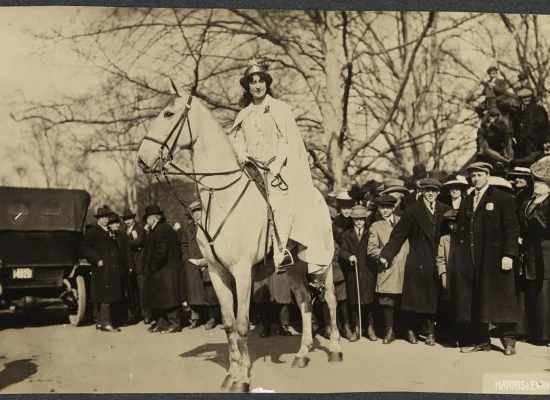
Last week, 20 poets gathered at the Arts Club of Washington for my workshop. Thank you so much to those who came out! It was incredibly fulfilling to read and discuss these poems together and to hear the beautiful pieces you all wrote — in only 10 minutes!
For those who weren’t able to join us in person, I wanted to share the prompts and sample poems with you as well.
What is an “after” poem?
- Writers (and all types of artists) often respond to and reflect on texts (art) that came before us. Whether it’s a retelling of a fairy tale, a parody, or a confrontation with a previous work, this form or method can create a powerful connection, or intertextuality, across mediums.
- “After” poems, as the name implies, are written after or about another piece of writing. These poems are inspired by, in response to, in conversation with, in homage to, or in the style of other poems (or other forms of art). They can generate dialogue, honor, subvert, or reclaim.
- A similar form is the ekphrastic poem, which vividly describes a piece of visual art (e.g., “Ode on a Grecian Urn” by John Keats; Corona/Crown by Kim Roberts Meikle).
Is this just plagiarism with a fancy name?
- What’s the line between “after” poems and plagiarism or theft? There isn’t one, though there are copyright laws. “After” poems shouldn’t be derivative or a direct copy. The idea is to draw inspiration from and create a new piece. How is your poem a response to the other piece of writing (art), how does it speak to the other piece?
- When you write an “after” or ekphrastic poem, it’s important to credit the original writer/artist who inspired the work. You’ll often see poets providing attribution after a title, after the final stanza, or in an acknowledgements section. Poems can even include footnotes, especially if they reuse direct lines/quotes from another piece. There’s not one right way to provide credit, just be sure you do credit your fellow writers (artists). This avoids claims of plagiarism — and is good literary citizenship.
- When writing “after” poems, poet Chen Chen asks: “Do I need to borrow this form or this language in these ways? Why? What am I adding to the history, the legacy, the larger/longer conversation of these words or ways of saying? … Are there artists, people I would be harming by citing or borrowing from them, in this fashion?”
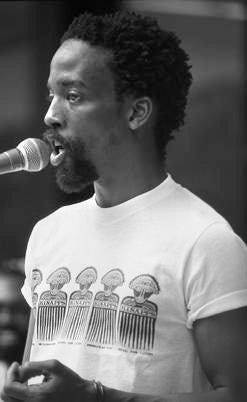
Essex Hemphill was born in Chicago and grew up in Southeast Washington, D.C. He openly addressed race, identity, sexuality, HIV/AIDS, and family in his work, voicing issues central to the African American gay community. His first collections of poems were the self-published chapbooks Earth Life (1985) and Conditions (1986). His first full-length collection, Ceremonies: Prose and Poetry (1992), won the National Library Association’s Gay, Lesbian, and Bisexual New Author Award. Hemphill studied English at the University of Maryland. He edited the anthology Brother to Brother: New Writing by Black Gay Men (1991), which won the Lambda Literary Award, received fellowships from the National Endowment for the Arts and grants from the Pew Charitable Trust Fellowship in the Arts and the DC Commission on the Arts and Humanities. Hemphill died of complications from AIDS in 1995.
Song for Rapunzel

Essex Hemphill

His hair
almost touches
his shoulders.
He dreams
of long braids,
ladders,
vines of hair.
He stands
like Rapunzel,
waiting on his balcony
to be rescued
from the fire-breathing
dragons of loneliness.
They breathe
at his hips
and thighs
the years soften
as they turn.
How long must he dream
ladders no one climbs?
He stands like Rapunzel,
growing deaf,
waiting
for a call.
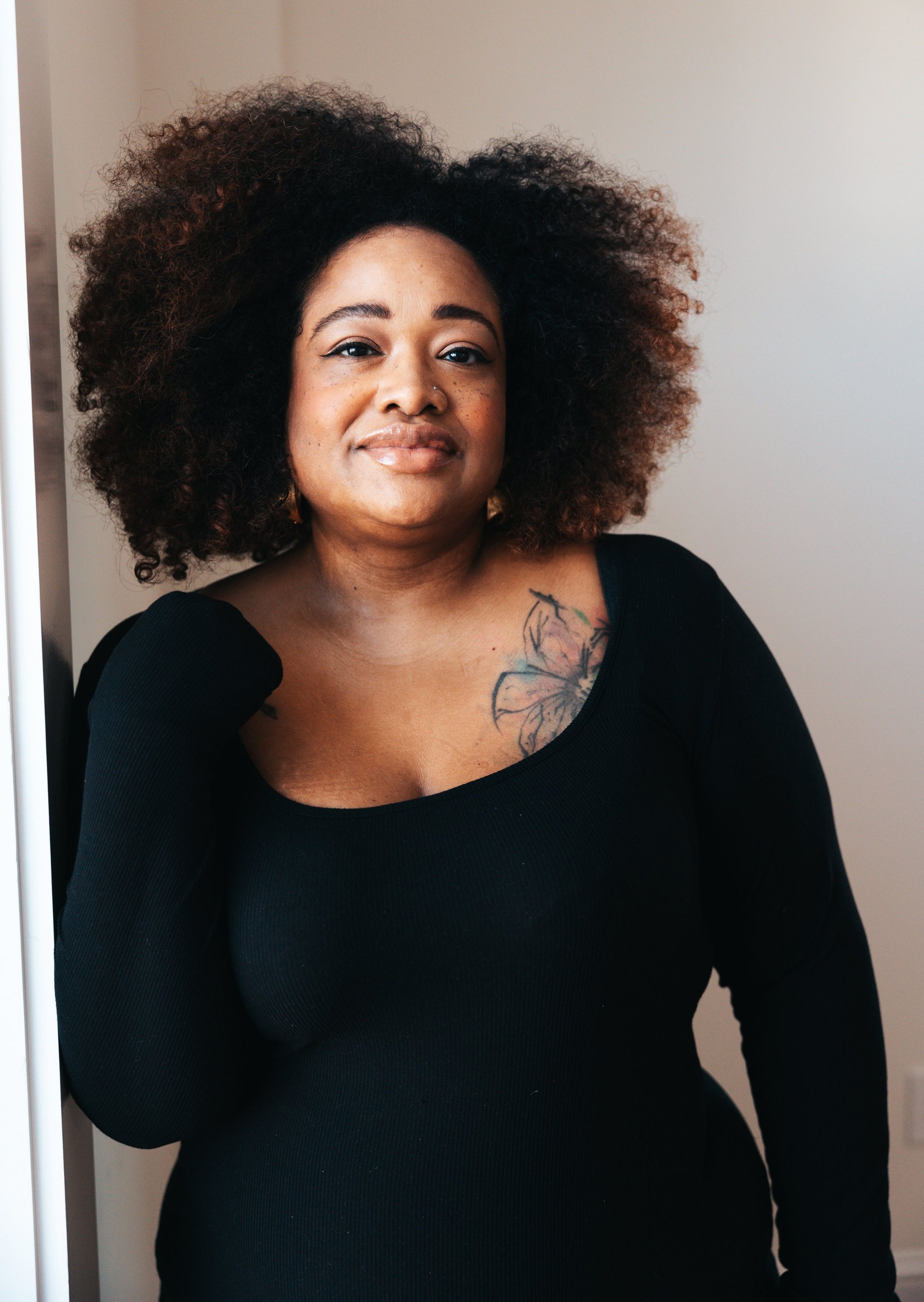
Saida Agostini is a queer Afro-Guyanese poet. Saida’s first collection of poems, let the dead in (Alan Squire Publishing, 2022), was a finalist for the Center of African American Poetry & Poetics’ 2020 Book Prize as well as the New Issues Poetry Prize. She is the author of STUNT (Neon Hemlock, 2020), a chapbook exploring the history of Nellie Jackson, a Black woman entrepreneur who operated a brothel for sixty years in Natchez, Mississippi. Her poetry can also be found in the Black Ladies Brunch Collective’s anthology Not Without Our Laughter: Poems of Humor, Joy and Sexuality (Mason Jar Press, 2017), edited by celeste doaks. She is a Cave Canem Graduate Fellow.
Adventures of the Third Limb

Saida Agostini

I want to name our cock chocolate thunder, tammy thinks
I have lost my mind. I see our cock as a blaxploitation heroine
resplendent in the finest of neon spandex, draped in golden chains
and a velvet cape, stiff in resolution to kick any jive turkey punk
muthafucka ass into submission.

our cock has framed pictures of prince on the wall, and listens
to deon estus to show her sensitive side.

she is fluent in seven languages, drinks dos equis, can paint, sing gospel,
praise dance and is head usher at the church of dynamic discipleship.
our cock is the renaissance dick, and if you are looking at her sideways:
bitch, what has your cock done for you lately?

our cock doesn’t hide when company comes, stalks out butt naked
in sequined pumps, shining with lube, sits spread eagled on
the dinner table and says embarrassing shit about things she
would do to kerry washington.

and when everyone else leaves, and only the three of us are left,
all limbs and laughter, she pulls me and tammy closer, our pussies
    climbing
up her veined girth.

this is how we fit together-loud, tight and eager, our wails her
composition, agitated aching notes-accesso and broken
chord. in the studio later with smokey, outfitted in a double breasted
stacey adams suit, matching gators, pinky ring and straw panama
    hat, she’ll share a blunt,
and then play cruisin while talking shit about how hard we came,
    and the scent of wet
— but in that moment, oh! my love!
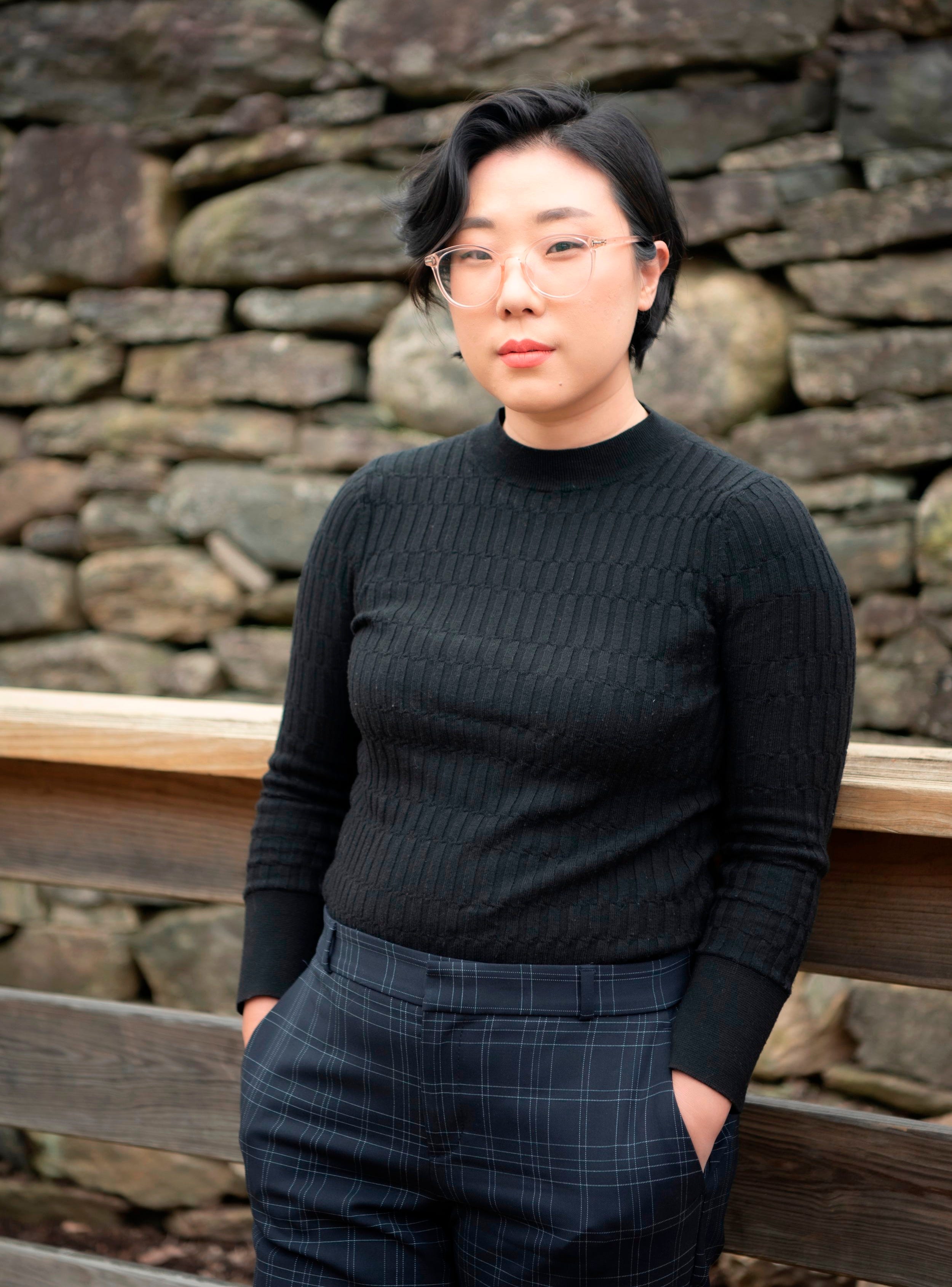
Franny Choi (they/she) is the author of The World Keeps Ending, and the World Goes On (Ecco Books 2022), Soft Science (Alice James Books, 2019), Floating, Brilliant, Gone (Write Bloody Publishing, 2014), and a chapbook, Death by Sex Machine (Sibling Rivalry Press, 2017). They co-edited the anthology We the Gathered Heat: Asian American and Pacific Islander Poetry, Performance, and Spoken Word. Franny is a member of the Literature Faculty at Bennington College and the Poet Laureate of Northampton, MA.
& O, bright star of disaster, I have been lit.

Franny Choi

     after Lo Kwa Mei-En

i have come & come here a thousand times,
gone by many names. trust: i am no god,

only woodworm, only termite burrowing
like a light in the flesh. i am no insect,

only an ache on loop in the window.
be honest. the wounds have been bearable

thus far. & who isn't bruised around the edges,
peaches poured into the truckbed, receipts

faded to white? i have only ever wanted to bite
down hard on whatever was offered to my hot,

grasping mouth. & here i am, licking corners
like a nervous cat, squirming in the hallway

outside the bathroom. i pick up the accent
of whoever i'm speaking to. nobody wants

to fuck a sponge. nobody wants to crush
on a ghost. o sure, we all do it anyway:

flickering screen; falsies batting; a story
of a story of a girl, or country, or a clean house

where everyone knows her place. my face
is a game of telephone gone sour, or south.

fleshy marionette in the window, dancing
her awful, crooked dance. & isn't that

what you paid for? isn't that what you came
to see?          a god, on loop, failing?
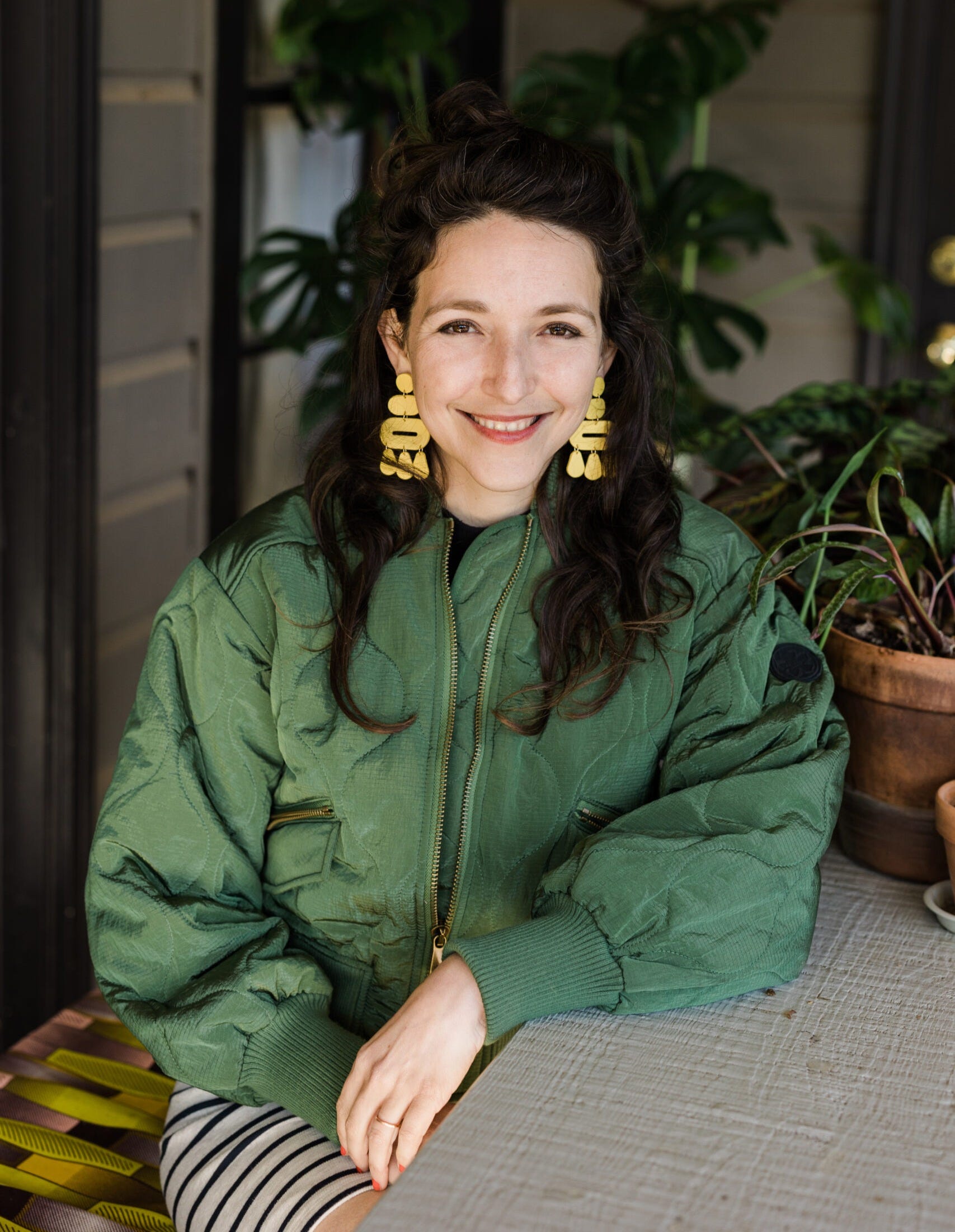
Nomi Stone is the author of the poetry collections Pinelandia: An Anthropology and Field Poetics of War and Empire (University of California Press, 2022), Kill Class (Tupelo Press, 2019) and Stranger’s Notebook (TriQuarterly Books, 2008). She earned an MFA from Warren Wilson College, an MA in Middle Eastern Studies from Oxford University, and a PhD in Cultural Anthropology from Columbia University. A former Fulbright scholar in creative writing in Tunisia, she has received poetry fellowships and grants from the Vermont Studio Center and the DC Commission for the Arts and Humanities, and she has won a Pushcart Prize. Stone is a postdoctoral research fellow in Anthropology at Princeton University.
On World-Making

Nomi Stone

To love is to tell the story of the world.     There was
an ocean with a boat     mountains     a meadow     too painful to stare
at directly. Haven’t I been here before? Yes.     No:     not quite here.

“It is not as if,” the philosopher writes, “an I exists
independently over here and then simply loses a you over there.”
In the mist, a man rigs the Suzelle, little red boat.
Loved labored for months, learning to tie the right knot. The exact

and only knot that will keep the vessel tethered. She rehearsed
for the worst possible thing. “The attachment to you,” it is written,
“is part of what composes who I am.” I know/knew
those hands, hers. I watched her dust the sourdough with flour

at midnight a moon between her fingers.     Gone
went Loved. But the half-world of her in me
was me.     It was lit by the moon.


Notes: All quotes are from Judith Butler.
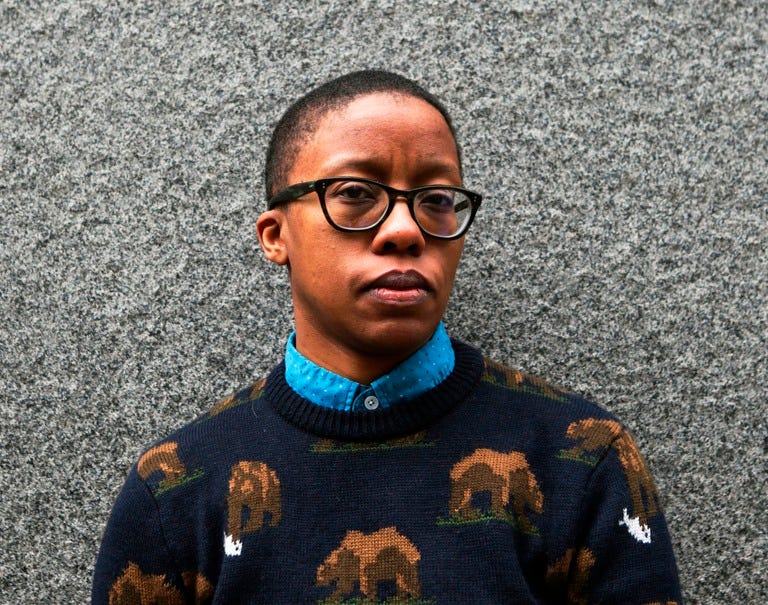
Donika Kelly is the author of three poetry collections: The Natural Order of Things (Graywolf Press, 2025), The Renunciations (Graywolf Press, 2021), and Bestiary (Graywolf Press, 2016). Bestiary was the winner of the 2015 Cave Canem Poetry Prize, the 2017 Hurston/Wright Award for poetry, and the 2018 Kate Tufts Discovery Award. A recipient of a fellowship from the National Endowment for the Arts, Kelly is a Cave Canem graduate fellow and Pushcart Prize winner. She earned her MFA in Writing from the Michener Center for Writers and a PhD in English from Vanderbilt University. Kelly teaches creative writing at the University of Iowa.
Offering

Donika Kelly

     after Mary Oliver

Here is the meat
and fat and bone
of the day. The smoke
too for the god of recognition.

A love offering,
where love is also
grief and mourning,
the business of waking
and moving in a body far
away from you,
sweet friend.

Where waking
and moving mean
crying or not crying,
but always breathing.

Mark how the light
bends through the dry
air, like breath,
at the end of the day.

Mark the chirbling of the bird
outside my window.

Mark the day we will see
one another again,
and what light there will be,
what song.
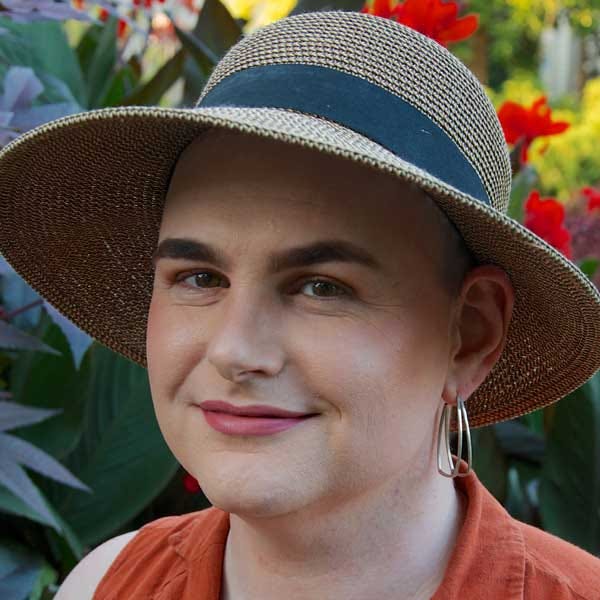
Ava Nathaniel Winter is the author of Transgenesis (Milkweed Editions, 2024), a winner of the National Poetry Series, and the poetry chapbook Safe House (Thrush Press, 2013). Ava served as a Stadler Fellow at Bucknell University and received an Individual Excellence Award from the Ohio Arts Council. She holds an MFA from The Ohio State University and a PhD from the University of Nebraska—Lincoln, where she teaches in the Department of English and the Women’s and Gender Studies Program.
Midrash

Ava Nathaniel Winter

Mordekhai fed and sustained. Really?! Indeed, Rabbi Yudan said, “One time, he went repeatedly to all the wet-nurses but could not find one for Esther at this moment, and so he nursed her himself.” Rabbi Berakhiah and Rabbi Abbahu [said] in Rabbi El’azar’s name, “Milk came to him and he would nurse her.”
—“Bereshit Rabbah”

The milk of a body like mine,
first seen and named as male,
budding against expectation,
fed and sustained the small girl-body
of Esther, whose story
feeds and sustains.

When I was a child,
our rabbi became a queen
flaming through the Purim spiel
in a tacky harem costume,
a mockery of the terrors
passed down in our blood.

I offer this blessing to you,
reader, sibling, sister. The milk
of a male may feed and sustain.
This is not a question, for me,
of belief. The body is holy
and is made holy in its changing.
Prompts
Prompt 1:
Find a line from one of the sample poems that strikes you. Respond to it, write in conversation with it, honor or question it. This line can become the first line of your poem, be placed elsewhere in your poem, or not appear at all.
Prompt 2:
Consider a fairy tale, fable, or myth. (You could also think about a song or visual piece of art, if fairy tales/fables/myths aren’t inspiring you). How can it be twisted, challenged, or reexamined? Does it hold up in 2026? Is there something you want to change?