Gesher Tzar Me’od
My sister and I barely made our transfer in Frankfurt. We were meeting my dad and stepmom in Kraków, Poland. We planned to explore the city for a few days then travel to Auschwitz and Birkenau for a guided tour of the concentration camps, to pay our respects to the Chertocks who never made it out of Auschwitz alive.
As we stepped up to passport control, the German border guard asked me what I was doing in Germany. An ancestral shudder oozed through me. Had my family been asked the same question 82 years ago1 in a more accusatory manner? You’re not real Germans, you’re filthy Jews. What are you doing in Germany?
My family isn’t sure how many Chertocks were murdered at Auschwitz. While the Nazis kept meticulous records, they destroyed most of the transport lists, records of who was gassed, and other documents before the camp’s liberation.
We have an old black and white photograph of our family from before the war. I can place my hand in the middle, separating the half who survived and the other half who didn’t.
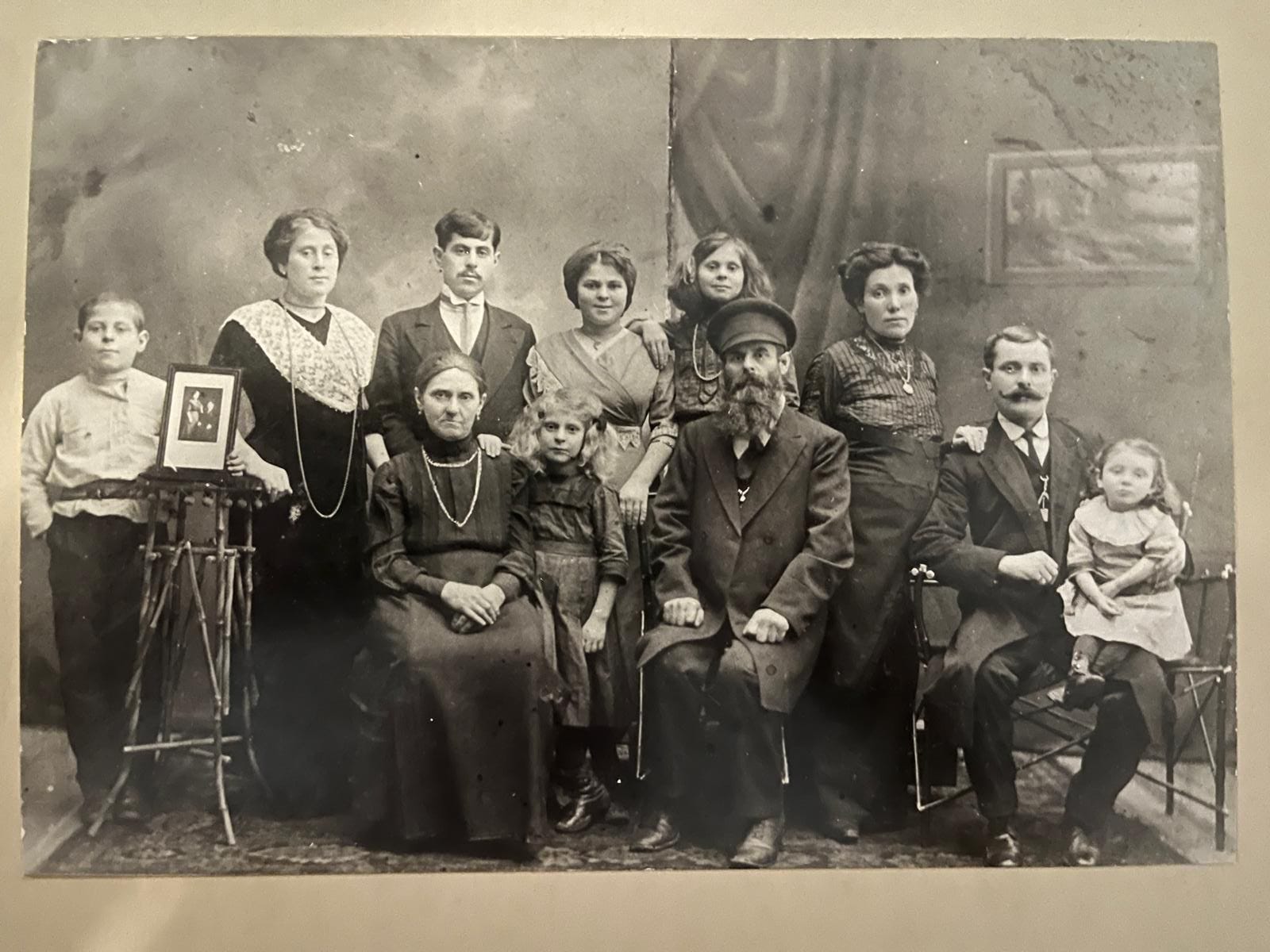
Who were they — who would they have become? Artists, builders, doctors, musicians, poets, scientists, teachers, writers? What kind of work did my paternal family engage in, and were they limited because of having spondyloepiphyseal dysplasia, my hereditary bone disorder, were they always in pain? Would any of them have invented something that would have helped humanity, cured a disease? Would any of them have been recognized with a Nobel Prize? What would they have done, if they were just allowed to live? How would they have filled their time, what hobbies would they have developed, what books did they like to read, what music did they listen or dance to, what did they do to relax?
We were traveling merely six months after my hip replacement surgery. The trip came together somewhat last minute for me — my sister was traveling through Poland and Germany with family and a friend. When she made plans to meet up with my dad and stepmom to travel to Auschwitz together, it felt like I should go with them, that this was a once in a lifetime experience I didn’t want to miss out on as a family.
Kraków was chosen as a sort of not quite in-between Washington, D.C. and my dad and stepmom’s home in Israel. Only my stepmom had been to the concentration camps before, in high school. Many Israeli high school students go on educational trips to Holocaust sites in Poland.
My Holocaust education started in Hebrew school when I was elementary school-aged. We read “Night” by Elie Wiesel, learned about Kristallnacht, discussed how Hitler and Nazis came to power. When I was 13, my Bubbie took me and my sister to the Avalon Theatre to see “Paper Clips”, a documentary about a middle school in a very rural Christian community in Tennessee that was looking for an effective way to teach their students about the scale of the Holocaust. The students ended up collecting 6 million paper clips to represent the 6 million Jews killed by the Nazis.
In high school history class, we focused on the Allies and Axis powers. (American high school history curriculum, at least when I was in school, definitely could have been better). At my socialist hippie Jewish summer camp (another story for a later essay), we discussed the Warsaw Ghetto Uprising and visited Yad Vashem, the World Holocaust Remembrance Center in Jerusalem, Israel, where we saw piles of shoes, eyeglasses, and jewelry taken from murdered Jews.
On my own, I read about the Jewish youth movements that led resistance to persecution Jews faced ahead of and during the Holocaust. (My Jewish summer camp is part of one such youth movement — that connection to my fellow Jews is incredibly meaningful). And I learned about the pre-Holocaust anti-Jewish laws in Germany (1933-1939), passed by the Nazi regime to systematically exclude Jews from economic, social, and political life. These laws stripped German Jews of their citizenship, rights, property, and employment, leading to total segregation in ghettos.
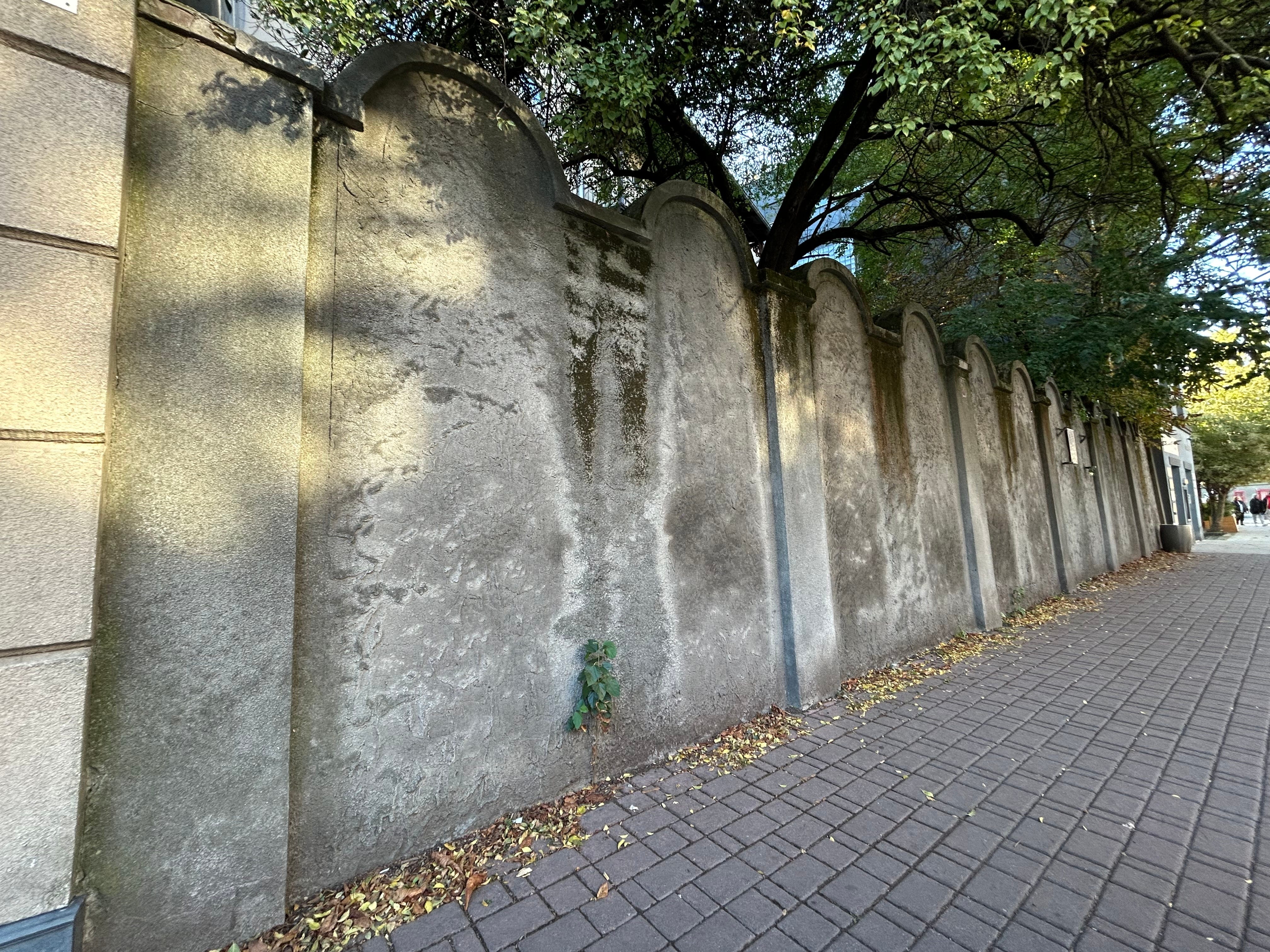
So, only six months post-op, I prepared to travel internationally. My gait and walking stamina were not great. Only a few weeks before, I was relying on a cane to help me with my balance while my muscles grew stronger with physical therapy, exercise, and time. Walking cane-free was new, and I decided to bring it with me in case I needed to use it to walk through the city or get through the airport.
I worried about not being able to keep up with the tour guide and rest of the group. About needing to sit down and rest so my right foot wouldn’t remain numb. But I doubted there’d be benches at a concentration camp. Not like it’s a nice spot in the park to people watch.
Touring Auschwitz and Birkenau so soon after a hip replacement was an eerie, emotional experience. That ancestral shiver revisited me many times while in Kraków. I felt it when we had to pay to enter Auschwitz, the resting place of my ancestors. The extermination camp has been turned into a memorial and museum, yes, but shouldn’t survivors and relatives — really, shouldn’t all Jews — be given free entry into these monuments to the horror of our annihilation? (I guess the free Smithsonian museums in Washington, D.C. have warped my sense of museums around the world).
The ancestral shudder rushed through my body when I stood in front of the permanent exhibition on physical evidence of crime, in Block 5 of the Auschwitz I main camp, where adaptive devices are piled high behind a glass display wall in one of the original brick barracks. Back braces, canes, casts, orthopedic devices. Molds of Jewish bodies made from plaster of Paris (just like my scoliosis brace was made for me when I was 13). Assistive tools for children, adults, the disabled, the elderly. The exhibit displays 470 prostheses and orthoses — a mere fraction of the true amount from the victims.
There’s piles of shoes, eyeglasses, tallit, suitcases, and hair as well, each behind a glass pane. The suitcases have names scribbled on them — a last-minute cruel joke the Nazis played, providing some kind of hope that they’d be receiving their luggage at a later time, when really the SS went through them all, kept any valuables.
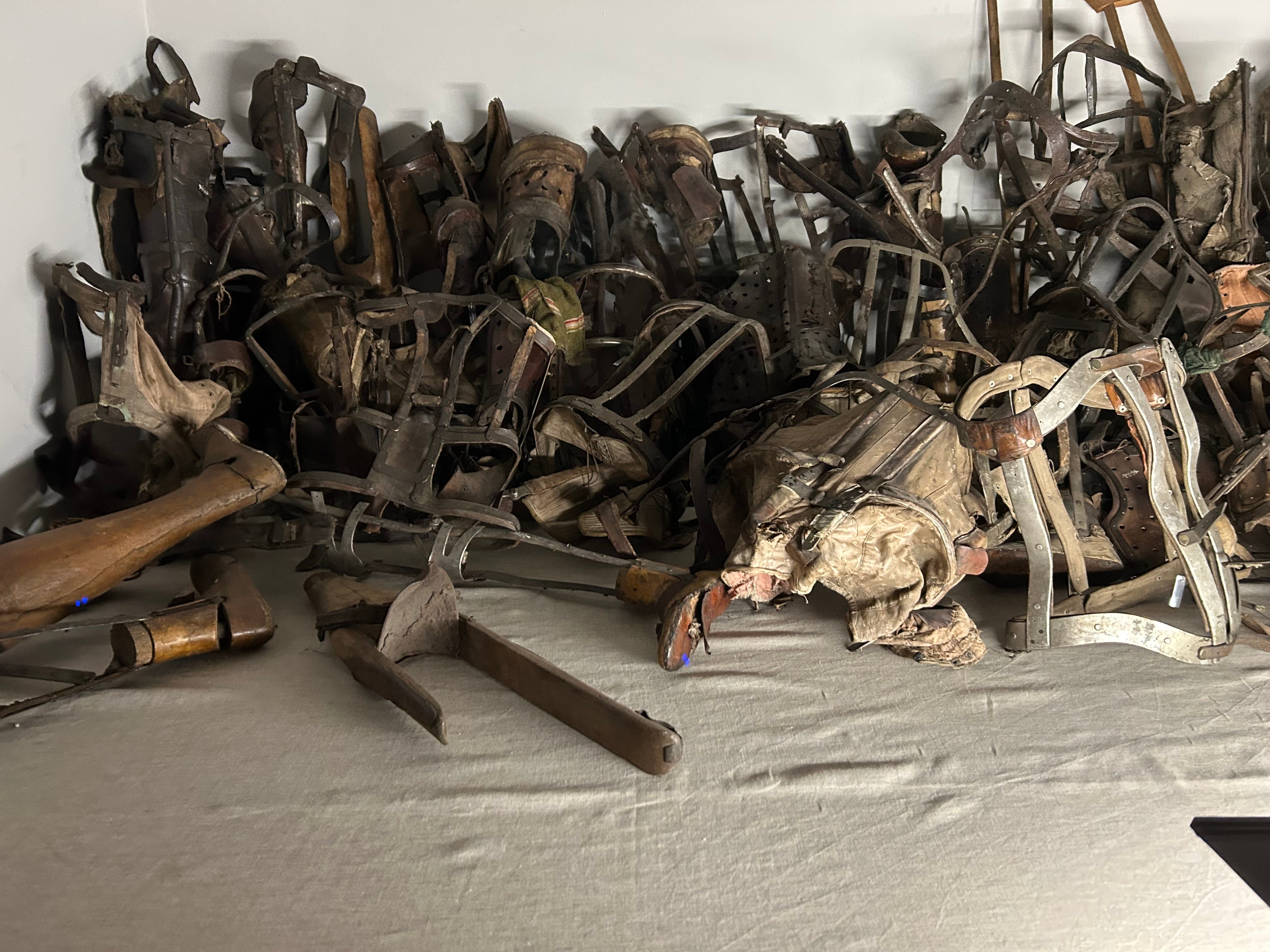
Looking at these adaptive devices, I knew I would’ve been sent to the gas chambers when the train I was on first pulled up to the camp, and we were lined up by the Nazi guards, and inspected, and sent to work if you were able-bodied enough and directly to the gas chambers if you weren’t, which, my body isn’t and would not have been back then either. Did any of my ancestors have spondyloepiphyseal dysplasia? Were they all gassed immediately upon arrival? Did any escape that death, only to be forced to do hard labor, with a body filled with deteriorating joints, a body in pain at rest, like mine?
As I stood there, a custodian sprayed glass cleaner and wiped the glass. Another shuffled a broom across the cement floor.
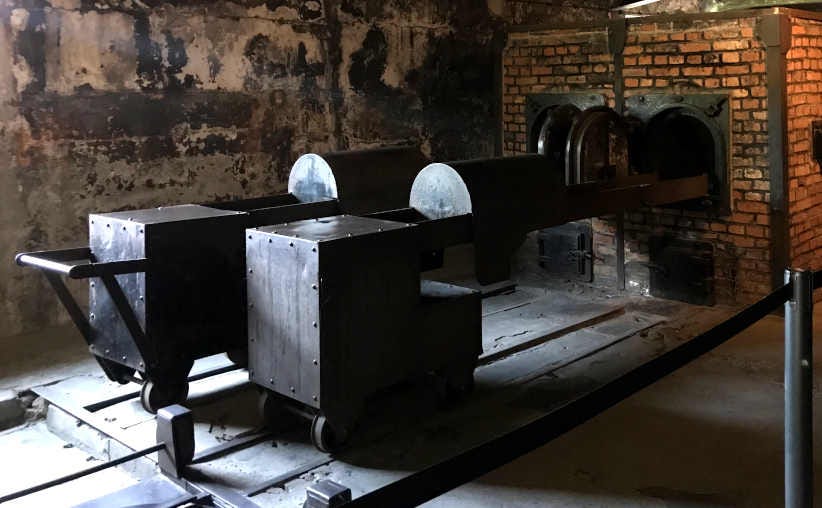
When we walked through the gas chamber itself, the walls were stained with human-shaped black markings. The silence was restless. The Chertocks were here, my family members were shoved into this horrific murder room, the breath choked out of them with Zyklon-B2. Their bodies then dragged to the incinerators to be burned, their ashes puffed out of the smokestacks and over the rest of the camp. Maybe they died together, as a family. More likely, the Chertock children, and elderly, and disabled (possibly all of my family; our bone condition comes from this side) were murdered first.
As I stared at the crematorium, another custodian began wiping it down. I realize museums and memorials have to be cleaned, but it was disconcerting to witness the resting place of my ancestors being readied for the next tour group. Just a daily routine for the cleaning staff at Auschwitz.
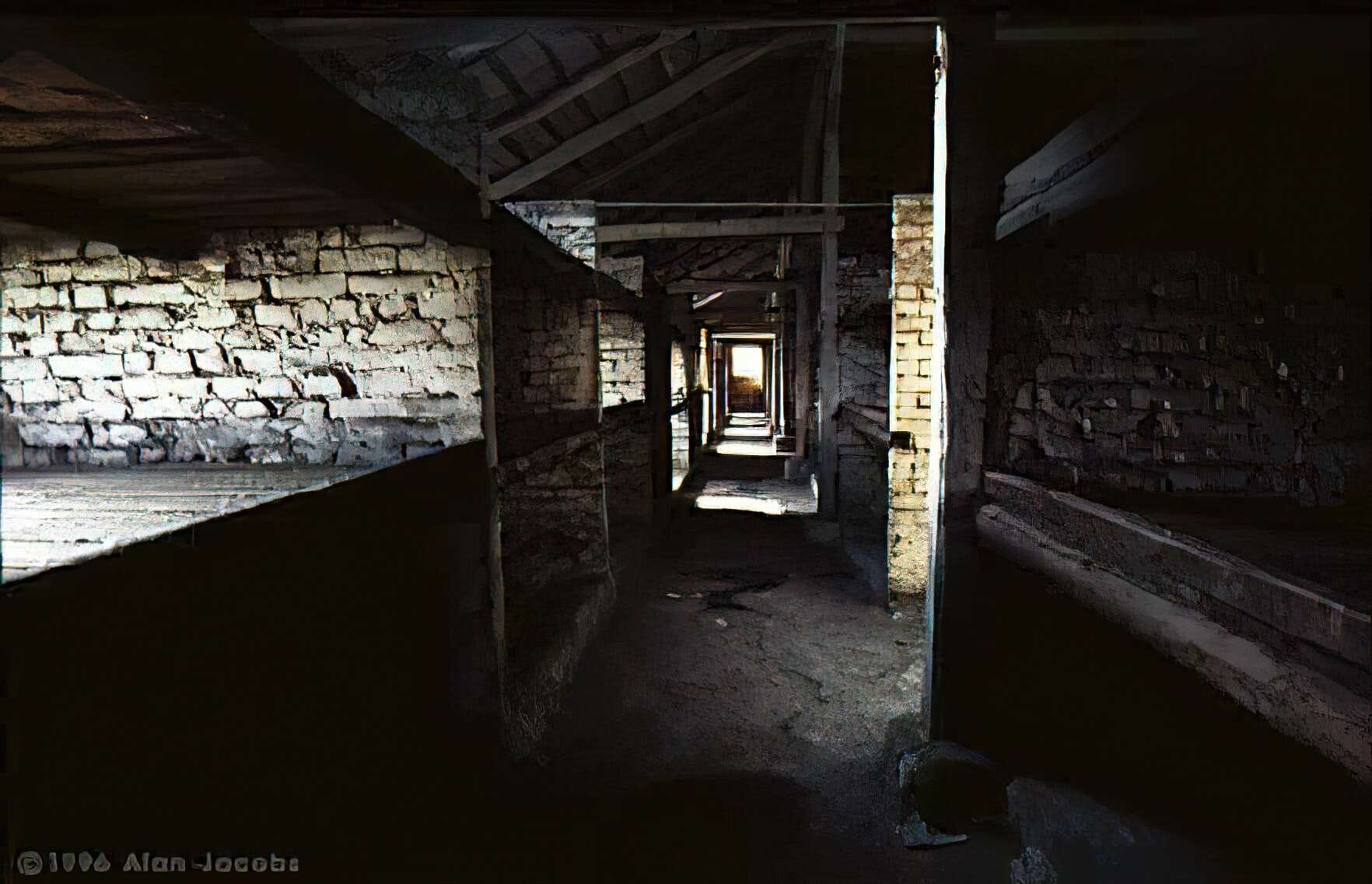
At Birkenau, we entered a women’s barrack. The wooden platform beds still intact, the brick building sturdily standing. Most of the buildings in the concentration camps were built to last; the only ones that have crumbled were ones the Nazis haphazardly destroyed before fleeing when the Red Army and Americans were approaching.
It was dark inside the barracks. I lost my footing, tripped off the raised wooden walkway, fell, and caught myself in the dirt path below. It wasn’t a far fall, but any fall is tough for a short person and someone who’s recently had a joint replacement surgery.
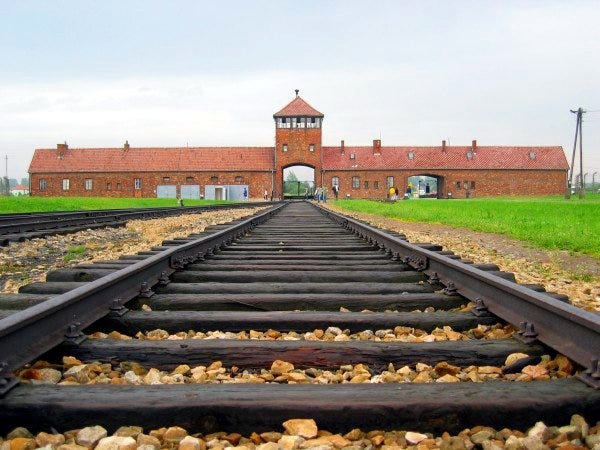
After that, my hip muscles were inflamed and my feet were throbbing from walking and standing for nearly 8 hours. I could barely make it back to the tour van. I limped from the last barracks we visited, past the train tracks that entered Birkenau — the infamous arched doorway to hell — past the snack shops, into the parking lot across the street.
How did my ancestors survive? How did they manage to do forced daily labor, avoid disease, stay warm in the harsh winter, walk the long length of the camp — especially if any of them had my bone disorder? Then I remembered: they didn’t.
The Chertocks who were sent to Auschwitz in the 1940s never left. Their ashes remain on that land. (There’s a pitifully small concrete stone monument to the dead in Auschwitz, located near sites where ashes were dumped. The plaque reads: “To the memory of the men, women and children who fell victim to the Nazi genocide. Here lie their ashes. May their souls rest in peace.”).
I wonder if we should have said the Mourner’s Kaddish. Would that have been respectful to our ancestors? Would we have even been able to, on a rushed guided tour?
The Nazis tried their best to erase my family, to make sure my last name was never uttered again on this earth. But I’m here. A Chertock, 80-some years later. There’s a whole generation of Chertocks — my dad, my sister, my brother, my stepmom, cousins, uncles, and aunts — we are the descendants of our family members who left Grodno, Poland before the war or during. Who made it across the perilous Atlantic Ocean on a steamship. Who built a life in Buffalo, opened a jewelry shop, married, had kids.
I don’t know how to end this essay. But the words of Rabbi Nachman of Breslov3 echoed in my head during my time in Kraków.
כָּל הָעוֹלָם כֻּלּוֹ גֶּשֶׁר צַר מְאוֹד וְהָעִקָּר לֹא לְפַחֵד כְּלָל

The whole entire world is a very narrow bridge
and the main thing to recall is to have no fear at all.
He shared this 200-some years ago, and דור לדור (dor l’dor [generations later]), Jews still learn and sing it. We sang it at my Jewish summer camp — the Hebrew and English words echoing through the חדר אוכל (chadar ochel [dining hall]). Reminding us that the world is terrifying and full of challenges; and also, that we must keep living in spite of that.
Did my paternal family members sing “Kol Ha’Olam Kulo”4 in the ghettos of Grodno? Did my maternal family members chant it in the shtetls of Russia? Did they pass it to their children, urge them not to be afraid, to live as a proud, visible Jew — at an era when Jews were very much in the minority, were restricted to settling in certain areas of countries or within their own villages, an era of rampant antisemitism (as it always seems to be).
On Yom HaShoah5 — and every day — may I find the courage to live as “Kol Ha’Olam Kulo” urges, to draw from the bravery of my ancestors. To be a Jew — visible, proud. Alive. Still here. Still a Chertock, on this earth. Like Rabbi Nachman, I can only hope my words will extend the lifetime of our family for as long as possible.
- My family lived in Grodno, Poland (now Belarus). The majority of Grodno’s Jews were murdered at Auschwitz and Treblinka during 1942 and 1943, as part of the liquidation of the Grodno ghettos, which began in November 1942. ↩︎
- The Nazis used Zyklon-B, a pesticide, to annihilate Europe’s Jews as well as Roma, disabled people, homosexuals, and Soviet and Polish prisoners of war. A cruelness in English: the cans were labeled “GIFTGAS”, German for “poison gas”. ↩︎
- Rabbi Nachman (1772–1810) founded the Braslov Hasidic movement. He was the great-grandson of the Baal Shem Tov, the founder of the Hasidic Movement. ↩︎
- “Kol Ha’Olam Kulo” is a song inspired by Rabbi Nachman of Breslov’s reflection on fear and how to live with courage. ↩︎
- Yom HaShoah, or, in full, Yom HaZikaron laShoah ve-laG’vurah, is Holocaust Remembrance Day. Falling on the 27th of Nisan on the Hebrew calendar, it is Israel’s day of commemoration focusing on Jewish resistance and loss. ↩︎